Semana 14: Unidad 4
Actividades
Actividad 5
- Fecha: octubre 6 de 2020 - 8 a.m.
- Descripción: ejercicios de la unidad 4
- Recursos: ingresa al grupo de Teams
- Duración de la actividad: 1 hora 40 minutos de discusión
- Forma de trabajo: colaborativo con solución de dudas en tiempo real.
La semana pasada te comenté que cuando DISEÑAS un programa orientado a objetos también debes considerar las relaciones entre esos objetos. Pues bien, en general hay dos tipos:
- Relaciones TO-HAVE o HAS-TO (TIENE UN)
- Relaciones TO-BE o IS-A (ES UN) (¿recuerdas la herencia?)
Vamos a concentrarnos primero en las TO-HAVE: la composición y la agregación.
Ejercicio 1
¿Qué es una relación de composición?
Dos objetos tienen una relación de composición cuando uno de ellos contiene a otro objeto. Debes tener en cuenta que en una relación de composición la VIDA del objeto contenido depende de la vida del objeto contenedor, es decir, si el objeto contenedor muere, el objeto contenido también. Cuando el objeto contenedor se va destruir, primero tendrá que hacerse con el objeto contenido.
Mira de nuevo este código:
1 2 3 4 5 6 7 8 9 10 11 12 13 14 | #include "queue.h"
#include <stdlib.h>
static void init(queue_t* this, int size) {
this->front = 0;
this->rear = 0;
this->arr = (double*)malloc(size * sizeof(double));
}
queue_t* create(int size){
queue_t* q = malloc(sizeof(queue_t));
init(q,size);
return(q);
}
|
Observa la función create. Dicha función crear una queue.
¿Qué datos componen la cola?
1 2 3 4 5 6 7 | typedef struct {
int front;
int rear;
double* arr;
} queue_t;
#endif
|
A su vez se en init estamos creando un nuevo objeto que no es más
que un arreglo de size doubles. La relación entre estos dos objetos
es de composición.
Ahora nota que al momento de destruir el objeto contenedor, primero se destruye el objeto contenido:
1 2 3 4 | void destroy(queue_t* this){
free(this->arr);
free(this);
}
|
Ejercicio 2
¿Qué es la agregación?
En esta relación tenemos también un objeto contenedor y un objeto contenido, la gran diferencia con la composición es que la vida del objeto contenido no depende de la vida del objeto contenedor. El objeto contenido puede ser construido incluso antes de que el objeto contenedor sea construido.
MINI-RETO
Con todo lo anterior en mente y esta nueva definición, te tengo un mini RETO:
Implementa un programa en C modelado con objetos que implemente una relación de agregación para esta situación: ” …el jugador recoge un arma, la usa varias veces y luego la tira…”
Note
¡Alerta de Spoiler!
Una posible implementación a este mini-reto la puedes ver en el siguiente código tomado de este . Le hice unas pequeñas modificaciones al código para que puedas ver el resultado en la terminal.
gun.h:
1 2 3 4 5 6 7 8 9 10 11 12 13 14 15 16 17 18 19 20 21 22 23 24 | #ifndef GUN_H_
#define GUN_H_
typedef int bool_t;
// Type forward declarations
struct gun_t;
// Memory allocator
struct gun_t* gun_new();
// Constructor
void gun_ctor(struct gun_t*, int);
// Destructor
void gun_dtor(struct gun_t*);
// Behavior functions
bool_t gun_has_bullets(struct gun_t*);
void gun_trigger(struct gun_t*);
void gun_refill(struct gun_t*);
#endif /* GUN_H_ */
|
gun.c:
1 2 3 4 5 6 7 8 9 10 11 12 13 14 15 16 17 18 19 20 21 22 23 24 25 26 27 28 29 30 31 32 33 34 35 36 37 38 39 40 41 | #include <stdlib.h>
#include <stdio.h>
typedef int bool_t;
// Attribute structure
typedef struct {
int bullets;
} gun_t;
// Memory allocator
gun_t* gun_new() {
return (gun_t*)malloc(sizeof(gun_t));
}
// Constructor
void gun_ctor(gun_t* gun, int initial_bullets) {
gun->bullets = 0;
if (initial_bullets > 0) {
gun->bullets = initial_bullets;
}
}
// Destructor
void gun_dtor(gun_t* gun) {
// Nothing to do
}
// Behavior functions
bool_t gun_has_bullets(gun_t* gun) {
return (gun->bullets > 0);
}
void gun_trigger(gun_t* gun) {
gun->bullets--;
printf("gun triggered\n");
}
void gun_refill(gun_t* gun) {
gun->bullets = 7;
}
|
player.h:
1 2 3 4 5 6 7 8 9 10 11 12 13 14 15 16 17 18 19 20 21 22 | #ifndef PLAYER_H_
#define PLAYER_H_
// Type forward declarations
struct player_t;
struct gun_t;
// Memory allocator
struct player_t* player_new();
// Constructor
void player_ctor(struct player_t*, const char*);
// Destructor
void player_dtor(struct player_t*);
// Behavior functions
void player_pickup_gun(struct player_t*, struct gun_t*);
void player_shoot(struct player_t*);
void player_drop_gun(struct player_t*);
#endif /* PLAYER_H_ */
|
player.c:
1 2 3 4 5 6 7 8 9 10 11 12 13 14 15 16 17 18 19 20 21 22 23 24 25 26 27 28 29 30 31 32 33 34 35 36 37 38 39 40 41 42 43 44 45 46 47 48 49 50 51 52 53 54 55 | #include <stdlib.h>
#include <string.h>
#include <stdio.h>
#include "gun.h"
// Attribute structure
typedef struct {
char* name;
struct gun_t* gun;
} player_t;
// Memory allocator
player_t* player_new() {
return (player_t*)malloc(sizeof(player_t));
}
// Constructor
void player_ctor(player_t* player, const char* name) {
player->name = (char*)malloc((strlen(name) + 1) * sizeof(char));
strcpy(player->name, name);
// This is important. We need to nullify aggregation pointers
// if they are not meant to be set in constructor.
player->gun = NULL;
}
// Destructor
void player_dtor(player_t* player) {
free(player->name);
}
// Behavior functions
void player_pickup_gun(player_t* player, struct gun_t* gun) {
// After the following line the aggregation relation begins.
player->gun = gun;
}
void player_shoot(player_t* player) {
// We need to check if the player has picked up th gun
// otherwise, shooting is meaningless
if (player->gun) {
gun_trigger(player->gun);
} else {
printf("Player wants to shoot but he doesn't have a gun!\n");
exit(1);
}
}
void player_drop_gun(player_t* player) {
// After the following line the aggregation relation
// ends between two objects. Note that the object gun
// should not be freed since this object is not its
// owner like composition.
player->gun = NULL;
}
|
main.c:
1 2 3 4 5 6 7 8 9 10 11 12 13 14 15 16 17 18 19 20 21 22 23 24 25 26 27 28 29 30 31 32 33 34 35 36 37 38 39 40 41 42 43 44 45 | #include <stdio.h>
#include <stdlib.h>
#include "gun.h"
#include "player.h"
int main(int argc, char* argv[]) {
// Create and constructor the gun object
struct gun_t* gun = gun_new();
gun_ctor(gun, 3);
// Create and construct the player object
struct player_t* player = player_new();
player_ctor(player, "Billy");
// Begin the aggregation relation.
player_pickup_gun(player, gun);
// Shoot until no bullet is left.
while (gun_has_bullets(gun)) {
player_shoot(player);
}
// Refill the gun
gun_refill(gun);
// Shoot until no bullet is left.
while (gun_has_bullets(gun)) {
player_shoot(player);
}
// End the aggregation relation.
player_drop_gun(player);
// Destruct and free the player object
player_dtor(player);
free(player);
// Destruct and free the gun object
gun_dtor(gun);
free(gun);
return 0;
}
|
Ejercicio 3
¿Recuerdas que en tu curso de programación y diseño orientado a objetos vistes las relaciones anteriores?
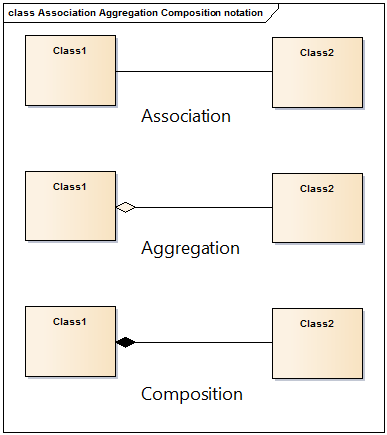
En ese curso a los dos relaciones anteriores: agregación y composición se les denomina en general asociaciones, es decir, dos objetos pueden estar asociados mediante una relación de agregación o composición.
Estas relaciones pueden mostrarse de manera gráfica utilizando un lenguaje de modelado conocido como UML. Te dejo aquí una imagen:
Ejercicio 4
¿Te animas a realizar un modelo UML para nuestros dos ejemplos de composición y agregación?
Actividad 6
- Fecha: octubre 6 a octubre 8 de 2020
- Descripción: trabajo autónomo en los ejercicios
- Recursos: ejercicios de la unidad 4
- Duración de la actividad: 4 horas
- Forma de trabajo: individual, trabajo autónomo.
Para estas cuatro horas de trabajo autónomo te propondré revisar el otro tipo de relación que nos falta: TO-BE, mejor conocida como herencia. También visitaremos de nuevo (lo estudiante en tu curso de POO) el concepto de polimorfismo.
Ejercicio 5
¿Cómo funciona la herencia?
En términos simples, la herencia permite añadirle a un objeto atributos de otro objeto.
1 2 3 4 5 6 7 8 9 10 11 12 13 | typedef struct {
char first_name[32];
char last_name[32];
unsigned int birth_year;
} person_t;
typedef struct {
char first_name[32];
char last_name[32];
unsigned int birth_year;
char student_number[16]; // Extra attribute
unsigned int passed_credits; // Extra attribute
} student_t;
|
En el ejemplo anterior (tomado del de aquí nota los atributos de la estructura person_t y student_t. ¿Ves alguna relación entre ellos?
student_t extiende los atributos de person_t. Por tanto, podemos decir que student_t también
ES UN (IS-A) person_t.
Observa entonces que podemos escribir de nuevo el código anterior así:
1 2 3 4 5 6 7 8 9 10 11 | typedef struct {
char first_name[32];
char last_name[32];
unsigned int birth_year;
} person_t;
typedef struct {
person_t person;
char student_number[16]; // Extra attribute
unsigned int passed_credits; // Extra attribute
}student_t;
|
¿Ves lo que pasó? estamos anidando una estructura en otra estructura. Por tanto student_t hereda de person_t. Observa que un puntero a student_t estará apuntando al primer atributo que es un person_t. ¿Lo ves? Por eso decimos que un student_t también ES UN person_t. Míralo en acción aquí:
1 2 3 4 5 6 7 8 9 10 11 12 13 14 15 16 17 18 19 20 21 22 | #include <stdio.h>
typedef struct {
char first_name[32];
char last_name[32];
unsigned int birth_year;
}person_t;
typedef struct {
person_t person;
char student_number[16]; // Extra attribute
unsigned int passed_credits; // Extra attribute
} student_t;
int main(int argc, char* argv[]) {
student_t s;
student_t* s_ptr = &s;
person_t* p_ptr = (person_t*)&s;
printf("Student pointer points to %p\n", (void*)s_ptr);
printf("Person pointer points to %p\n", (void*)p_ptr);
return 0;
}
|
Ejercicio 6
En este punto te pido que te pongas cómodo. Lo que viene será alucinante…
Del ejercicio anterior concluimos que student_t está heredando de person_t. Por tanto, a las funciones que definas para manipular un objeto de tipo person_t también le puedes pasar un puntero a un student_t (para manipular sus atributos correspondiente a person_t). SEÑORES y SEÑORAS, estamos reutilizando código.
Ejercicio 7
Ahora te voy a mostrar una técnica para implementar herencia simple en C. Analiza con detenimiento este código por favor (tomado de aquí):
person.h:
1 2 3 4 5 6 7 8 9 10 11 12 13 14 15 16 17 18 19 20 21 22 23 24 | #ifndef PERSON_H_
#define PERSON_H_
// Forward declaration
struct person_t;
// Memory allocator
struct person_t* person_new();
// Constructor
void person_ctor(struct person_t*,
const char* /* first name */,
const char* /* last name */,
unsigned int /* birth year */);
// Destructor
void person_dtor(struct person_t*);
// Behavior functions
void person_get_first_name(struct person_t*, char*);
void person_get_last_name(struct person_t*, char*);
unsigned int person_get_birth_year(struct person_t*);
#endif /* PERSON_H_ */
|
person.c:
1 2 3 4 5 6 7 8 9 10 11 12 13 14 15 16 17 18 19 20 21 22 23 24 25 26 27 28 29 30 31 32 33 34 35 36 37 38 | #include <stdlib.h>
#include <string.h>
#include <stdlib.h>
#include "personPrivate.h"
// Memory allocator
person_t* person_new() {
return malloc(sizeof(person_t));
}
// Constructor
void person_ctor(person_t* person,
const char* first_name,
const char* last_name,
unsigned int birth_year) {
strcpy(person->first_name, first_name);
strcpy(person->last_name, last_name);
person->birth_year = birth_year;
}
// Destructor
void person_dtor(person_t* person) {
// Nothing to do
}
// Behavior functions
void person_get_first_name(person_t* person, char* buffer) {
strcpy(buffer, person->first_name);
}
void person_get_last_name(person_t* person, char* buffer) {
strcpy(buffer, person->last_name);
}
unsigned int person_get_birth_year(person_t* person) {
return person->birth_year;
}
|
personPrivate.h:
1 2 3 4 5 6 7 8 9 10 11 12 | #ifndef PERSONPRIVATE_H_
#define PERSONPRIVATE_H_
// Private definition
typedef struct {
char first_name[32];
char last_name[32];
unsigned int birth_year;
} person_t;
#endif /* PERSONPRIVATE_H_ */
|
student.h:
1 2 3 4 5 6 7 8 9 10 11 12 13 14 15 16 17 18 19 20 21 22 23 24 25 | #ifndef STUDENT_H_
#define STUDENT_H_
//Forward declaration
struct student_t;
// Memory allocator
struct student_t* student_new();
// Constructor
void student_ctor(struct student_t*,
const char* /* first name */,
const char* /* last name */,
unsigned int /* birth year */,
const char* /* student number */,
unsigned int /* passed credits */);
// Destructor
void student_dtor(struct student_t*);
// Behavior functions
void student_get_student_number(struct student_t*, char*);
unsigned int student_get_passed_credits(struct student_t*);
#endif /* STUDENT_H_ */
|
student.c:
1 2 3 4 5 6 7 8 9 10 11 12 13 14 15 16 17 18 19 20 21 22 23 24 25 26 27 28 29 30 31 32 33 34 35 36 37 38 39 40 41 42 43 44 45 46 47 48 49 50 51 52 53 54 55 56 57 58 | #include <stdlib.h>
#include <stdio.h>
#include <string.h>
#include "person.h"
#include "personPrivate.h"
//Forward declaration
typedef struct {
// Here, we inherit all attributes from the person class and
// also we can use all of its behavior functions because of
// this nesting.
person_t person;
char* student_number;
unsigned int passed_credits;
} student_t;
// Memory allocator
student_t* student_new() {
return (student_t*)malloc(sizeof(student_t));
}
// Constructor
void student_ctor(student_t* student,
const char* first_name,
const char* last_name,
unsigned int birth_year,
const char* student_number,
unsigned int passed_credits) {
// Call the constructor of the parent class
person_ctor((struct person_t*)student,
first_name, last_name, birth_year);
student->student_number = (char*)malloc(16 * sizeof(char));
strcpy(student->student_number, student_number);
student->passed_credits = passed_credits;
}
// Destructor
void student_dtor(student_t* student) {
// We need to destruct the child object first.
free(student->student_number);
// Then, we need to call the destructor function
// of the parent class
person_dtor((struct person_t*)student);
}
// Behavior functions
void student_get_student_number(student_t* student,
char* buffer) {
strcpy(buffer, student->student_number);
}
unsigned int student_get_passed_credits(student_t* student) {
return student->passed_credits;
}
|
main.c:
1 2 3 4 5 6 7 8 9 10 11 12 13 14 15 16 17 18 19 20 21 22 23 24 25 26 27 28 29 30 31 32 33 | #include <stdio.h>
#include <stdlib.h>
#include "person.h"
#include "student.h"
int main(int argc, char* argv[]) {
// Create and construct the student object
struct student_t* student = student_new();
student_ctor(student, "John", "Doe", 1987, "TA5667", 134);
// Now, we use person's behavior functions to
// read person's attributes from the student object
char buffer[32];
// Upcasting to a pointer of parent type
struct person_t* person_ptr = (struct person_t*)student;
person_get_first_name(person_ptr, buffer);
printf("First name: %s\n", buffer);
person_get_last_name(person_ptr, buffer);
printf("Last name: %s\n", buffer);
printf("Birth year: %d\n", person_get_birth_year(person_ptr));
// Now, we read the attributes specific to the student object.
student_get_student_number(student, buffer);
printf("Student number: %s\n", buffer);
printf("Passed credits: %d\n",
student_get_passed_credits(student));
// Destruct and free the student object
student_dtor(student);
free(student);
return 0;
}
|
Ejercicio 8
Ahora te voy a mostrar una técnica para implementar polimorfismo en tiempo de ejecución en C (tomado de aquí).
Pero antes ¿Qué es el polimorfismo en tiempo de ejecución? Antes mira qué te permite hacer el polimorfismo. Considera que tienes estos tres objetos:
1 2 3 4 5 6 7 8 | struct animal_t* animal = animal_new();
animal_ctor(animal);
struct cat_t* cat = cat_new();
cat_ctor(cat);
struct duck_t* duck = duck_new();
duck_ctor(duck);
|
cat y duck heredan de animal. Por tanto, como cat y duck son animal también, entonces al hacer esto:
1 2 3 4 | // This is a polymorphism
animal_sound(animal);
animal_sound((struct animal_t*)cat);
animal_sound((struct animal_t*)duck);
|
Consigues esta salida:
1 2 3 | Animal: Beeeep
Cat: Meow
Duck: Quack
|
Entonces puedes ver que la función animal_sound exhibe un comportamiento polimórfico dependiendo del tipo de referencia que le pasemos.
¿Para qué sirve esto? Supón que tienes un código base al cual quieres adicionarle funcionalidades nuevas. El polimorfismo te permite mantener el código base lo más intacto posible a medida que añades más comportamientos por medio de la herencia.
Ahora, si. Mira cómo se puede implementar:
animal.h:
1 2 3 4 5 6 7 8 9 10 11 12 13 14 15 16 17 18 19 20 21 | #ifndef ANIMAL_H_
#define ANIMAL_H_
// Forward declaration
struct animal_t;
// Memory allocator
struct animal_t* animal_new();
// Constructor
void animal_ctor(struct animal_t*);
// Destructor
void animal_dtor(struct animal_t*);
// Behavior functions
void animal_get_name(struct animal_t*, char*);
void animal_sound(struct animal_t*);
#endif /* ANIMAL_H_ */
|
animal.c:
1 2 3 4 5 6 7 8 9 10 11 12 13 14 15 16 17 18 19 20 21 22 23 24 25 26 27 28 29 30 31 32 33 34 35 36 37 38 | #include <stdlib.h>
#include <string.h>
#include <stdio.h>
#include "animalPrivate.h"
// Default definition of the animal_sound at the parent level
void __animal_sound(void* this_ptr) {
animal_t* animal = (animal_t*)this_ptr;
printf("%s: Beeeep\n", animal->name);
}
// Memory allocator
animal_t* animal_new() {
return (animal_t*)malloc(sizeof(animal_t));
}
// Constructor
void animal_ctor(animal_t* animal) {
animal->name = (char*)malloc(10 * sizeof(char));
strcpy(animal->name, "Animal");
// Set the function pointer to point to the default definition
animal->sound_func = __animal_sound;
}
// Destructor
void animal_dtor(animal_t* animal) {
free(animal->name);
}
// Behavior functions
void animal_get_name(animal_t* animal, char* buffer) {
strcpy(buffer, animal->name);
}
void animal_sound(animal_t* animal) {
// Call the function which is pointed by the function pointer.
animal->sound_func(animal);
}
|
animalPrivate.h:
1 2 3 4 5 6 7 8 9 10 11 12 13 14 15 16 | #ifndef ANIMALPRIVATE_H_
#define ANIMALPRIVATE_H_
// The function pointer type needed to point to
// different morphs of animal_sound
typedef void (*sound_func_t)(void*);
// Forward declaration
typedef struct {
char* name;
// This member is a pointer to the function which
// performs the actual sound behavior
sound_func_t sound_func;
} animal_t;
#endif /* ANIMALPRIVATE_H_ */
|
cat.h:
1 2 3 4 5 6 7 8 9 10 11 12 13 14 15 16 17 | #ifndef CAT_H_
#define CAT_H_
// Forward declaration
struct cat_t;
// Memory allocator
struct cat_t* cat_new();
// Constructor
void cat_ctor(struct cat_t*);
// Destructor
void cat_dtor(struct cat_t*);
// All behavior functions are inherited from the animal class.
#endif /* CAT_H_ */
|
cat.c:
1 2 3 4 5 6 7 8 9 10 11 12 13 14 15 16 17 18 19 20 21 22 23 24 25 26 27 28 29 30 31 32 33 34 | #include <stdio.h>
#include <stdlib.h>
#include <string.h>
#include "animal.h"
#include "animalPrivate.h"
typedef struct {
animal_t animal;
} cat_t;
// Define a new behavior for the cat's sound
void __cat_sound(void* ptr) {
animal_t* animal = (animal_t*)ptr;
printf("%s: Meow\n", animal->name);
}
// Memory allocator
cat_t* cat_new() {
return (cat_t*)malloc(sizeof(cat_t));
}
// Constructor
void cat_ctor(cat_t* cat) {
animal_ctor((struct animal_t*)cat);
strcpy(cat->animal.name, "Cat");
// Point to the new behavior function. Overriding
// is actually happening here.
cat->animal.sound_func = __cat_sound;
}
// Destructor
void cat_dtor(cat_t* cat) {
animal_dtor((struct animal_t*)cat);
}
|
duck.h:
1 2 3 4 5 6 7 8 9 10 11 12 13 14 15 16 17 18 19 | #ifndef DUCK_H_
#define DUCK_H_
// Forward declaration
struct duck_t;
// Memory allocator
struct duck_t* duck_new();
// Constructor
void duck_ctor(struct duck_t*);
// Destructor
void duck_dtor(struct duck_t*);
// All behavior functions are inherited from the animal class.
#endif /* DUCK_H_ */
|
duck.c:
1 2 3 4 5 6 7 8 9 10 11 12 13 14 15 16 17 18 19 20 21 22 23 24 25 26 27 28 29 30 31 32 33 34 35 | #include <stdio.h>
#include <stdlib.h>
#include <string.h>
#include "animal.h"
#include "animalPrivate.h"
typedef struct {
animal_t animal;
} duck_t;
// Define a new behavior for the duck's sound
void __duck_sound(void* ptr) {
animal_t* animal = (animal_t*)ptr;
printf("%s: Quacks\n", animal->name);
}
// Memory allocator
duck_t* duck_new() {
return (duck_t*)malloc(sizeof(duck_t));
}
// Constructor
void duck_ctor(duck_t* duck) {
animal_ctor((struct animal_t*)duck);
strcpy(duck->animal.name, "Duck");
// Point to the new behavior function. Overriding
// is actually happening here.
duck->animal.sound_func = __duck_sound;
}
// Destructor
void duck_dtor(duck_t* duck) {
animal_dtor((struct animal_t*)duck);
}
|
main.c:
1 2 3 4 5 6 7 8 9 10 11 12 13 14 15 16 17 18 19 20 21 22 23 24 25 26 27 28 29 30 31 32 | #include <stdio.h>
#include <stdlib.h>
#include <string.h>
// Only public interfaces
#include "animal.h"
#include "cat.h"
#include "duck.h"
int main(int argc, char** argv) {
struct animal_t* animal = animal_new();
struct cat_t* cat = cat_new();
struct duck_t* duck = duck_new();
animal_ctor(animal);
cat_ctor(cat);
duck_ctor(duck);
animal_sound(animal);
animal_sound((struct animal_t*)cat);
animal_sound((struct animal_t*)duck);
animal_dtor(animal);
cat_dtor(cat);
duck_dtor(duck);
free(duck);
free(cat);
free(animal);
return 0;
}
|
Actividad 7
- Fecha: octubre 8 de 2020 - 8 a.m.
- Descripción: trabaja en el reto y resuelve dudas en tiempo real con el docente sobre los ejercicios y el enunciado del RETO.
- Recursos: ingresa al grupo de Teams
- Duración de la actividad: 1 hora 40 minutos de discusión
- Forma de trabajo: colaborativo con solución de dudas en tiempo real.
Enunciado del RETO
Realiza un programa y su modelo de clases UML. Para una aplicación que permita crear bases de datos de estudiantes.
Cada registro de la base de datos estará dado por: número de cédula, nombre y semestre. Cada registro corresponde a un estudiante.
Implementa los siguientes comandos:
exit : salir del programa. Antes de terminar debe mostrar el nombre de la base de datos activa y solicitar si desea guardarla.
mdb nombre tamaño : crea EN MEMORIA una base de datos especificando el nombre y la cantidad de registros.
ldb nombre : carga TODA la base de datos en MEMORIA desde el archivo especificado. El comando debe indicar si la base de datos se cargó correctamente o no existe.
Una vez la base de datos esté cargada en memoria desde el archivo o con mdb
puedes aplicar los siguientes comandos:
lsdbs : este comando mostrará todas las bases de datos que tengas cargadas en la memoria indicando su nombre, tamaño y cantidad de registros almacenados.
gdb: muestra el nombre de la base de datos activa, qué tamaño tiene y cuántos registros le quedan disponibles.
sdb nombre: este comando selecciona la base de datos activa para aplicar los siguientes comandos:
svdb : este comando salva la base de datos activa en un archivo con el mismo nombre de la base de datos.
radb : lee todos los registros de la base de datos.
rsdb : lee la cantidad de registros de la base datos.
mreg cedula nombre semestre : crea un nuevo registro en la base de datos.
rr cédula : busca en la base de datos por número de cédula. En caso de encontrar la cédula imprime el registro completo.
No olvides:
- Cada comando deberá implementarse como una función.
- En un momento dado puedes tener
variasbases de datos en memoria.
Entrega
Crea una carpeta y luego comprímela SOLO en formato .ZIP. Incluye en la carpeta:
Actividad 8
- Fecha: octubre 8 a octubre 13 de 2020
- Descripción: soluciona el RETO
- Recursos: material de la unidad.
- Duración de la actividad: 4 horas
- Forma de trabajo: individual, trabajo autónomo.
Anexo
Note
¡ESTA SECCIÓN ES SOLO PARA PERSONAS MUY CURIOSAS!
En esta sección continuaremos explorando las ideas presentadas en este texto tan interesante.
Clases abstractas
¿Qué son las clases abstractas? Son un tipo de clases de las cuales no puedes crear OBJETOS. Entonces ¿Para qué sirven? Sirven para crear programas orientados a objetos que puedan extenderse al máximo y con la menor cantidad de dependencias entre sus componentes. ¿Te suena que vale la pena?
Mira este problema: tienes que construir una biblioteca que te permita comunicar, por un puerto serial, a Unity con un sensor. Las responsabilidades del código son: gestionar el puerto serial, gestionar la comunicación con el hilo principal o hilo del motor y enviar-recibir datos siguiendo un protocolo específico. En este escenario podrías escribir una biblioteca que resuelva este problema solo para el sensor particular o escribirla de tal manera que puedas reutilizar casi todo el código y solo cambiar el protocolo de comunicación si a futuro cambias de sensor.
¿Cuál de las dos opciones de suena más?
Si te suena más la segunda, entonces todas las partes comunes del código irán en la clase abstracta y las partes que varían, en este caso el protocolo de comunicación, irán en otra clase que herede de la clase abstracta. Aquí entra en juego el otro concepto que estudiamos, el POLIMORFISMO, ¿Cómo? En el código de la clase abstracta se llamará el código que varía o métodos VIRTUALES, pero este código no estará implementado. Por tanto, los métodos virtuales tendrás que implementarlo en la clase que hereda, de la cual, si PUEDES crear OBJETOS. Hermoso, ¿No?.
En lenguajes de programación como C# se hace así. En C++ sería así.
Ten presente que en la medida que llevas al extremo este concepto de abstracción podrás llegar a clases que no tengan atributos sino SOLO métodos virtuales. En este punto habrás llegado a las INTERFACES, de las cuales tampoco podrás crear objetos.